What Does It Mean to Build From Where You Are

A recurring idea runs through some of the most internationally recognized architecture coming out of Africa and its diaspora right now. Tradition isn't a reference applied after the design is finished. It's the starting logic the design is built from. Five architects, five very different answers.
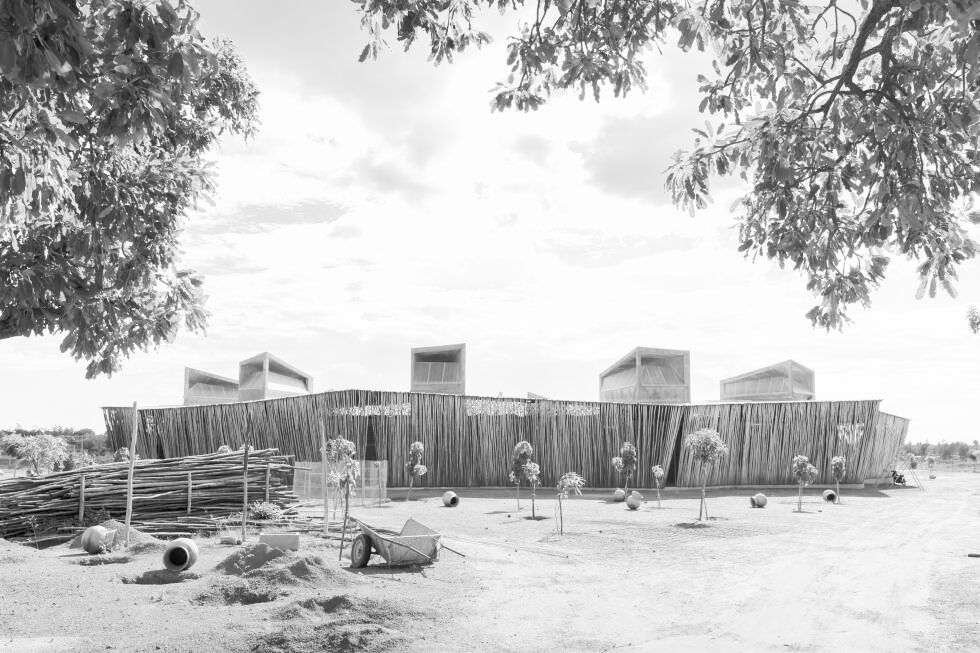
Diébédo Francis Kéré's Lycée Schorge Secondary School, in Koudougou, Burkina Faso, draws its ring-shaped courtyard plan directly from the spatial logic of traditional West African settlements, where clusters of structures around a shared center create their own microclimates. Wind towers rise from its roof modules, functioning independently of the region's inconsistent electrical grid. The full story of that building deserves its own telling elsewhere in this Journal. Here, it's enough to say that Kéré answered the question by looking at how people had already been building around him for generations, and simply refusing to look away from it.
David Adjaye answers a different version of the same question. The Smithsonian National Museum of African American History and Culture wasn't raised on African soil, in an African climate, from African materials. It stands on the National Mall in Washington, D.C. Its three-tiered bronze corona takes its shape from the Yoruba caryatid, a traditional West African column crowned with a supporting figure, and its perforated metal screen echoes ironwork forged by enslaved craftsmen in the American South. Adjaye wasn't building from a place. He was building from a history that had been carried somewhere else entirely, and had to find its own architecture once it arrived.

Mariam Kamara's Hikma Community Complex, in Dandaji, Niger, converted a derelict mosque into a library and added a new mosque beside it, built from materials sourced within three miles. Her team brought back the village's original masons to lead the work, teaching them updated adobe additives in the process, knowledge moving in both directions rather than expertise flowing only one way. The walls run up to seventy centimeters thick, thermal mass built for a climate that regularly exceeds 40°C.

Mphethi Morojele's Freedom Park, in Pretoria, brought in spiritual healers early in the design process to help identify what he has described as a kind of spiritual map across the site, guiding where different elements of the 52-hectare memorial should sit. Vernacular architectural knowledge was actively suppressed under apartheid, treated as having no validity at all. It was a reclamation of something that had been deliberately taken away.

Kunlé Adeyemi's Makoko Floating School addressed a constraint no imported model was built to solve, a dense waterfront community on Lagos's lagoon, almost no dry land available anywhere. The prototype sat on a pontoon of plastic barrels and was built with the Makoko community itself as part of the construction team. It has since evolved into a floating system now deployed across three continents, a solution built for one of Lagos's most specific conditions, now answering a question other coastlines didn't know they were asking.

It would be easy to read these five projects as proof that building from where you are always produces something better. That's worth being careful with. "Building from where you are" has also become, in the last decade, a story architects and clients both know is marketable, a narrative worth telling in a grant application or a design competition, whether or not it runs deeper than the story being told. None of these five projects reads as opportunistic. But the fact that the story is now valuable is itself worth noticing, since it changes the incentives around who tells it and how carefully.
None of this is ornament. In each case, the vernacular or historical element does real work, cooling a building, organizing a memorial, transferring a skill, floating a school on water with no other buildable ground.
Every one of these projects begins in a different place. None begins nowhere.
Comments