What Buildings Remember

The room stays cool through the hottest part of the afternoon without any machine doing the work. Outside, the courtyard stays empty until evening.
This is a house near Koudougou, raised the way houses in that region are raised, thick walls, small high windows, a roof that already knows what two in the afternoon feels like. Nobody who built it was solving a technical problem. They were building a house.
Not every building manages this.
What do some buildings remember that others forget?
A 2026 systematic review of passive cooling strategies drawn from African vernacular traditions found that combining strategies, rather than relying on any single one, produced indoor temperature reductions of 3 to 5°C.
A separate study comparing traditional and modern dwellings across western sub-Saharan Africa found that during the hot season, 60 to 70 percent of people in traditional buildings reported feeling comfortable. In modern houses nearby, only 20 percent did.
None of this is nostalgia wearing the costume of data. It's measurement, taken carefully, and it keeps landing in the same place.
Three buildings.
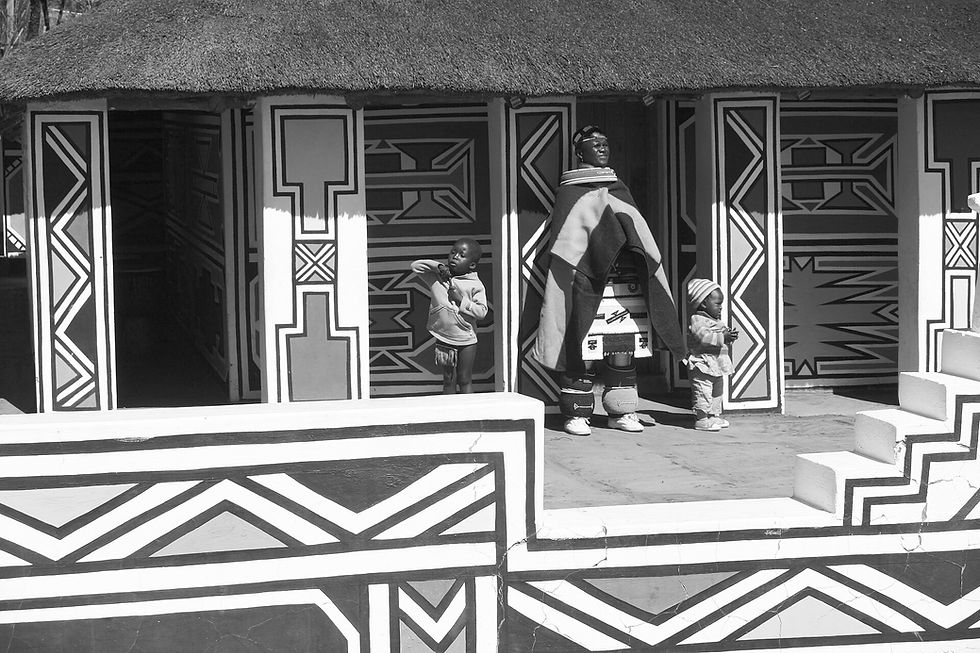
The Ndebele house, in South Africa and Zimbabwe, is finished entirely in mud, whitewashed with limestone, painted by hand using pigment drawn from the same earth the walls are formed from. Nothing about the surface hides what the structure is made of.
The Bamiléké family estate in Cameroon holds a courtyard, a kitchen, an attic, and a cemetery, maintained collectively by a family rather than a single owner. Children still cross that courtyard most afternoons, on their way between houses, past a tree old enough to have been there before any of them were born.
Great Zimbabwe, constructed between the 11th and 15th centuries entirely from dry stone, no mortar anywhere in it, is still standing. Not restored. Standing, eight centuries after the stone and the technique were first matched to each other.

The clearest proof that none of this logic is stuck in the past isn't old at all. Zimbabwe's Eastgate Centre, completed in 1996, uses roughly 35 percent less energy than comparable, conventionally air-conditioned buildings in Harare, and skipping a full HVAC system saved close to 10 percent of total construction cost. It manages this by borrowing directly from termite mounds and from older Zimbabwean masonry traditions. Forty-eight brick chimneys run along the roofline, pulling warm air out through a stack effect, no machinery required.

It would be easy to end here, on a note of quiet triumph. That would also be unfair. These methods carry real costs. Thick earth walls demand upkeep that falls on the people living inside them, not on a maintenance company somewhere else. Replastering, hand finishing, communal labor, none of it is free, it's simply paid for differently than a service contract. And these traditions didn't fade from neglect alone. Land tenure changed. Cities grew faster than anyone had planned for. Materials once gathered within walking distance became harder to reach as settlements outgrew their original footprint.
The buildings continued to perform long after architectural education had begun privileging different assumptions. As of 2017, thirteen English-speaking African countries were still validating architecture degrees against criteria set by the Commonwealth Association of Architects, a body whose standards were shaped by a different climate and a different set of materials entirely.
Somewhere tonight, a wall is being replastered by hand before the rains come. A courtyard somewhere is cooling itself without anything plugged in. Nobody documenting either of these things thinks of them as remarkable. They think of it as Tuesday.
Architecture forgets much faster than buildings do.
Comments