Five African Architects Turning Vernacular Tradition Into Contemporary Form
- NURU Editorial
- 4 days ago
- 3 min read
Updated: 13 hours ago
A recurring idea runs through some of the most internationally recognised architecture coming out of Africa and its diaspora right now: tradition isn't a decorative reference applied after the design is done. It's the starting logic the design is built from. Five architects make that case clearly, each in a different register.
Diébédo Francis Kéré
Kéré's Lycée Schorge Secondary School in Koudougou, Burkina Faso, draws its ring-shaped courtyard plan directly from the spatial logic of traditional West African settlements, where clusters of structures around a shared centre create their own microclimates. We've covered the project in depth elsewhere on the Knowledge Hub, but the short version is this: the wind towers rising from its roof modules are passive exhaust systems, no machinery, no energy cost, functioning independently of Burkina Faso's inconsistent electrical grid.
David Adjaye
The Smithsonian National Museum of African American History and Culture in Washington, D.C., opened in 2016 and remains one of the most visible examples of vernacular African form shaping a major public building outside the continent. Its three-tiered bronze "corona" façade takes its shape from a Yoruba caryatid, a traditional West African column topped with a crown-like form. Adjaye has described the choice as a way of placing an alternative model of classicism into a National Mall otherwise dominated by Greco-Roman reference points. The building's perforated metal screen additionally nods to ironwork crafted by enslaved African American artisans in the American South, tying the museum's exterior directly to the history it houses.
Mariam Kamara
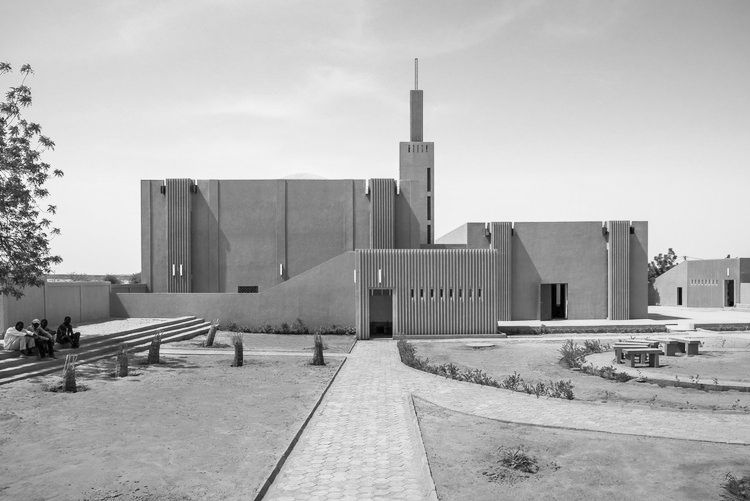
Kamara's Hikma Community Complex in Dandaji, Niger, completed in 2018, converted a derelict mosque into a library and added a new mosque alongside it, built from materials sourced within a three-mile radius. Her construction team brought back the village's original masons to lead the renovation, teaching them updated adobe-enhancing additives in the process, a transfer of knowledge that moved in both directions rather than a design simply imposed on the community. The complex uses laterite walls up to 70 centimetres thick for thermal mass in a climate that regularly exceeds 40°C.
Mphethi Morojele
Freedom Park in Pretoria, South Africa, completed in 2010, took an unusual design approach from the outset. Morojele, founder of MMA Design Studio, brought in spiritual healers early in the process to help identify what he has described as a kind of spiritual map of the site, informing where different elements of the 52-hectare memorial should sit. The park's 30-metre steel "reeds" are conceived as a conduit between earth and ancestors. Morojele has spoken about how vernacular architectural knowledge was actively suppressed under apartheid, treated as having no validity, making his deliberate return to indigenous design logic a pointed act rather than a stylistic choice.
Kunlé Adeyemi
Adeyemi's Makoko Floating School, built in 2013 for the stilt community of Makoko on Lagos's lagoon, addressed a specific and urgent constraint: a dense waterfront community with almost no dry land to build on. The prototype structure, roughly 220 square metres, sits on a pontoon of plastic barrels and was built with the Makoko community itself as part of the construction team. It was shortlisted for the Aga Khan Award for Architecture and later evolved into the Makoko Floating System, now deployed in five countries across three continents, proof that a solution built for one specific water community had wider relevance across Africa's rapidly urbanising coastal regions.

The Common Thread
None of these projects treat vernacular reference as ornament. In each case, the traditional element does structural, climatic, spiritual, or social work, cooling a building, organising a memorial site, transferring a skill, or floating a school on water that has no other buildable ground. That's the distinction worth paying attention to as more architects, in Africa and its diaspora, look to indigenous knowledge systems for answers modern construction hasn't fully solved on its own.
Architect | Project | Location | Year |
Diébédo Francis Kéré | Lycée Schorge Secondary School | Koudougou, Burkina Faso | 2016 |
David Adjaye | Smithsonian National Museum of African American History and Culture | Washington, D.C., USA | 2016 |
Mariam Kamara | Hikma Community Complex | Dandaji, Niger | 2018 |
Mphethi Morojele | Freedom Park | Pretoria, South Africa | 2010 |
Kunlé Adeyemi | Makoko Floating School | Lagos, Nigeria | 2013 |
Explore more projects, research, and opportunities shaping Africa's built environment on the NURU Knowledge Hub.


Comments